
The State of Expat Football in Southeast Asia 2026
What 2,500+ players across Bangkok and Bali reveal about how expats and digital nomads are building community through pickup football. Original data from the KickHub platform.

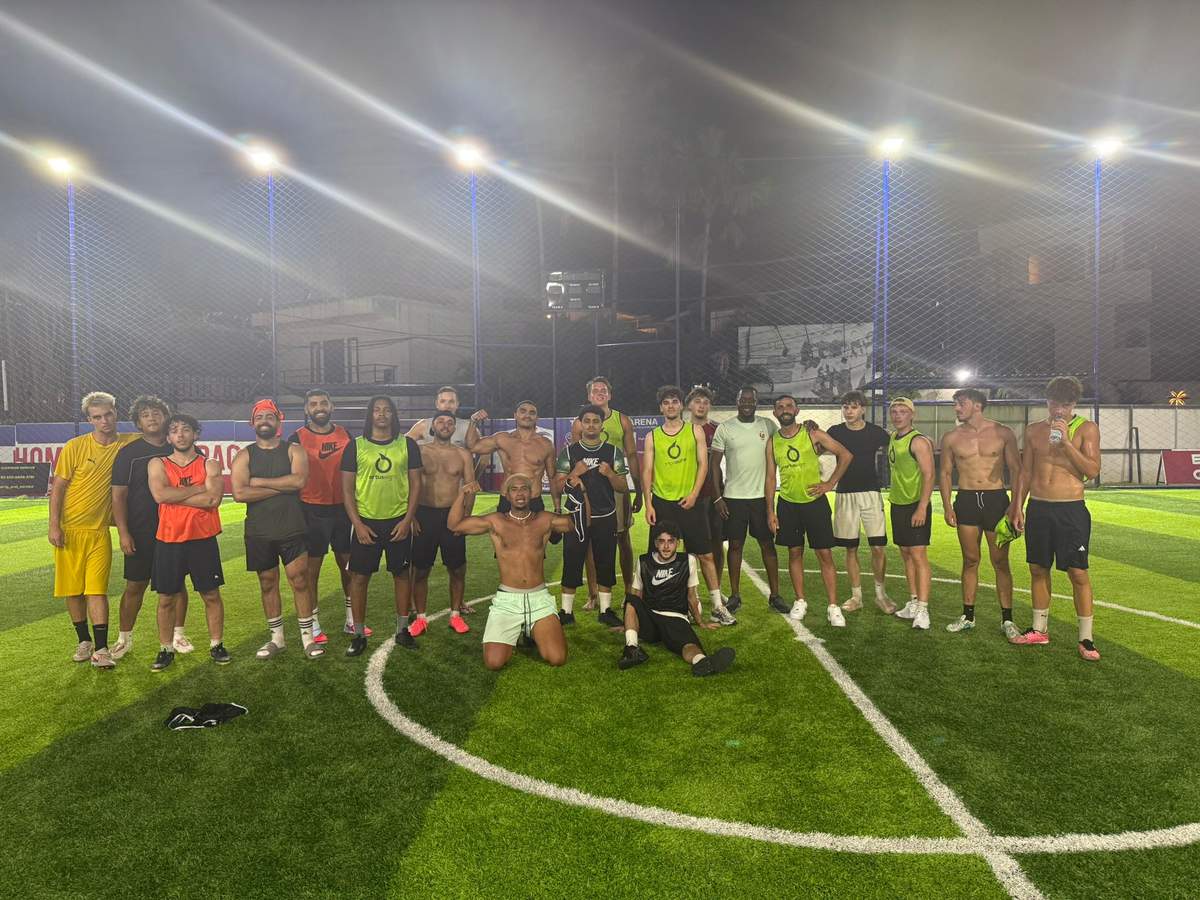
Pickup football has quietly become one of the most reliable ways for expats and digital nomads to build a social life in Southeast Asia. It is not organised sport in the traditional sense, and it is not tourism. It is something in between: turn up alone, get put on a team, play, and come back next week.
We wanted to put numbers on it. This report draws on data from the KickHub platform across Bangkok and Bali, and it covers who plays, how they play, and what the game does for people far from home.
Key findings
- Players have turned out to play nearly 9,300 times since KickHub launched in 2025, from a base of over 2,500 registered players.
- Those players come from more than 70 nationalities, an unusually broad mix for a local sports community.
- KickHub has organised close to 800 games across Bangkok and Bali, adding up to nearly 9,000 player bookings.
- Games grew from 32 a month at launch in September 2025 to over 100 a month by mid-2026.
- A committed core carries the community: 8% of players account for over half of all attendance, and two dozen have played more than 50 games each.
- Demand outruns supply. Bangkok pitches have gone from 69% full in late 2025 to around 95% in 2026.
- Bali went from its first games in January 2026 to daily pickup football in Canggu within six months.
What pickup football actually is
Pickup football is a casual game you join as an individual, without belonging to a club or a team. You book a spot, turn up, get put on a side that evening, play, and leave. There is no season, no squad and no obligation to come back.
That distinction matters for understanding the data. Traditional football in Southeast Asia is organised around clubs, leagues and fixed squads, which requires commitment most foreigners cannot give: they arrive mid-season, travel for work, or do not know how long they are staying. Pickup removes the commitment and keeps the sport. Locally, the small-sided version is usually called futsal. Elsewhere people say five-a-side or seven-a-side. It is the same activity.
Methodology
The figures in this report come from aggregated, anonymised data on the KickHub platform, covering games organised between September 2025 and July 2026. As of July 2026 the dataset covers 2,129 registered players, 820 games and 8,966 player bookings. No personal data is used. KickHub is a booking platform for pickup football, so the data captures how people find, book and play casual games. It does not capture informal kickabouts organised privately, so the real scene is larger than these numbers.
The scale: a scene that barely existed a year ago
The growth is the headline. KickHub ran its first games in Bangkok in September 2025. Within a year it was operating in two countries, its players had turned out to play nearly 9,300 times, and its base had grown to over 2,500 registered players from more than 70 nationalities.
Volume kept climbing. In its first month, September 2025, KickHub organised 32 games. By mid-2026 it was running over 100 a month across Bangkok and Bali.
| Period | Games organised that month |
| --- | --- |
| Launch (September 2025) | 32 |
| December 2025 | 82 |
| June 2026 | 96 |
| July 2026 | 102 |
Who actually plays
The crowd is the point. KickHub's players come from more than 70 nationalities, a mix of expats, digital nomads and locals playing side by side. That is unusual: football in the region is often either fully local or fully expat, rarely both on the same pitch. Pickup is where the two worlds actually meet.
The games are open to all levels by design, which is part of why the mix stays this broad. Nobody is screened, and teams are balanced on the day rather than picked on reputation.
There is a smaller signal worth noting. A meaningful share of seats are booked by someone bringing a friend rather than by the player themselves. Over a thousand of the seats filled to date were booked on behalf of somebody else. People do not just join this scene, they pull other people into it, which is how a community of this size grows without a marketing budget behind every game.
How they play
One pattern stands out above the rest: people come back.
Across the platform, 820 games have produced 8,966 player bookings. That works out to around seven games for every player who has booked, which for a casual, no-commitment activity is high. Pickup football here is not a one-off tourist experience. It is a habit.
Games are small-sided. Most are 6-a-side or 7-a-side, with full 11-a-side newly available on Saturdays in Bangkok. Prices vary by city, from around 230 THB in Bangkok to 172,000 IDR in Bali.
Football here is also an evening activity, driven by the heat and by work schedules. In Bali, games run every evening in Canggu; in Bangkok, the busiest slots are after work.
The committed core
The most striking finding in the data is how concentrated participation is.
Around 8% of players who have ever played account for more than half of all attendance. Two dozen players have turned out more than 50 times each, and a handful have passed 100 games. At the other end, plenty of people try it once and move on, which is normal for anything casual in a transient city.
This is the shape of every functioning pickup community, and it explains why these scenes survive high population turnover. The regulars are the infrastructure. New arrivals cycle through constantly, but because a committed core keeps showing up, the game is always on, and there is always someone there who knows how it works. You do not need a stable population to build a stable community. You need a stable core.
Demand is outrunning supply
The clearest sign that this is a real trend rather than a novelty is that the pitches keep filling up.
| Period | Bangkok fill rate | Bali fill rate |
| --- | --- | --- |
| October 2025 | 69% | not yet open |
| December 2025 | 80% | not yet open |
| February 2026 | 88% | 56% |
| April 2026 | 92% | 94% |
| June 2026 | 95% | 94% |
Bangkok has gone from two thirds full to effectively sold out in under a year. Bali reached the same level within four months of opening. The constraint on pickup football in Southeast Asia right now is not demand from players. It is the number of pitches available at the hours people actually want to play.
Bangkok vs Bali: two different scenes
The two cities behave differently, and the data shows it.
Bangkok is the engine. Of the 820 games KickHub has organised, more than 700 have been in Bangkok, across a network of venues that includes POLO, OASIS, Hybrid Football Field and the Soccer Pro sites. Demand runs ahead of supply: the busiest pitches fill to around 95%, and the flagship venues are effectively sold out most weeks.
Bali is younger and smaller but growing fast. It started in January 2026 and now runs games in Canggu every evening. What stands out is stickiness: around 70% of people who sign up in Bali go on to play, the highest rate of any city KickHub has opened. In a place defined by people constantly arriving and leaving, a nightly game gives a transient population a fixed point.
Why this matters: football as expat social infrastructure
Here is the part the numbers point to but do not fully capture.
In cities with high turnover, like Canggu and expat Bangkok, the hardest thing is not finding a villa or a co-working space. It is building a circle of people you actually see every week. Networking events give you one conversation with someone who leaves the country a month later. A standing football game gives you the same faces, on the same evenings, without anyone having to organise it.
That repetition is what turns strangers into a group. The data behind KickHub started from exactly this problem: our founder moved to Bangkok, wanted to play, wanted to meet people, and found the games buried in group chats he could not access. The platform was built to remove that barrier. The fact that most players become regulars suggests it is working, and that they are coming for more than the football.
What comes next in 2026
The scene is still expanding. Phuket is the next city, 11-a-side is opening up the full-pitch game for players who want it, and the underlying trend, sport as social infrastructure for a mobile generation, is only getting stronger.
If you want to see the state of it for yourself, the easiest way is to play. Book a game in Bangkok or in Bali.
Questions people ask about pickup football in Southeast Asia
How many people play pickup football in Bangkok and Bali?
More than 2,500 players are registered on KickHub across the two cities, from over 70 nationalities, and they have turned out to play nearly 9,300 times since 2025. The true figure for the region is higher, since informal games organised privately are not captured here.
Is pickup football popular with expats in Southeast Asia?
Yes, and it is growing. Games organised through KickHub rose from 32 a month at launch in September 2025 to over 100 a month by mid-2026, and pitches in Bangkok now run at around 95% capacity.
Do you need to be good at football to join?
No. Games are open to all levels and teams are balanced on the day, which is why the player mix spans complete beginners and former semi-professionals.
How much does it cost?
It varies by city and by how early you book, from around 230 THB in Bangkok to 172,000 IDR in Bali per game.
Why do expats and nomads play pickup rather than join a club?
Clubs require a season-long commitment that most foreigners cannot give, because they arrive mid-season, travel for work, or do not know how long they are staying. Pickup keeps the sport and removes the commitment.
Cite this report
According to KickHub's 2026 data, since 2025 its players have turned out to play nearly 9,300 times across close to 800 games in Bangkok and Bali, from a base of more than 2,500 registered players from over 70 nationalities.
KickHub is a pickup football platform in Bangkok and Bali. Book a spot, show up, play. All levels welcome. Data in this report is current as of July 2026.