
How to Join a Pickup Football Game (Even If You're Nervous)
What pickup football is, and exactly how to join your first game alone in Bangkok or Bali. What to expect, how to book, and why the nerves disappear ten minutes in.

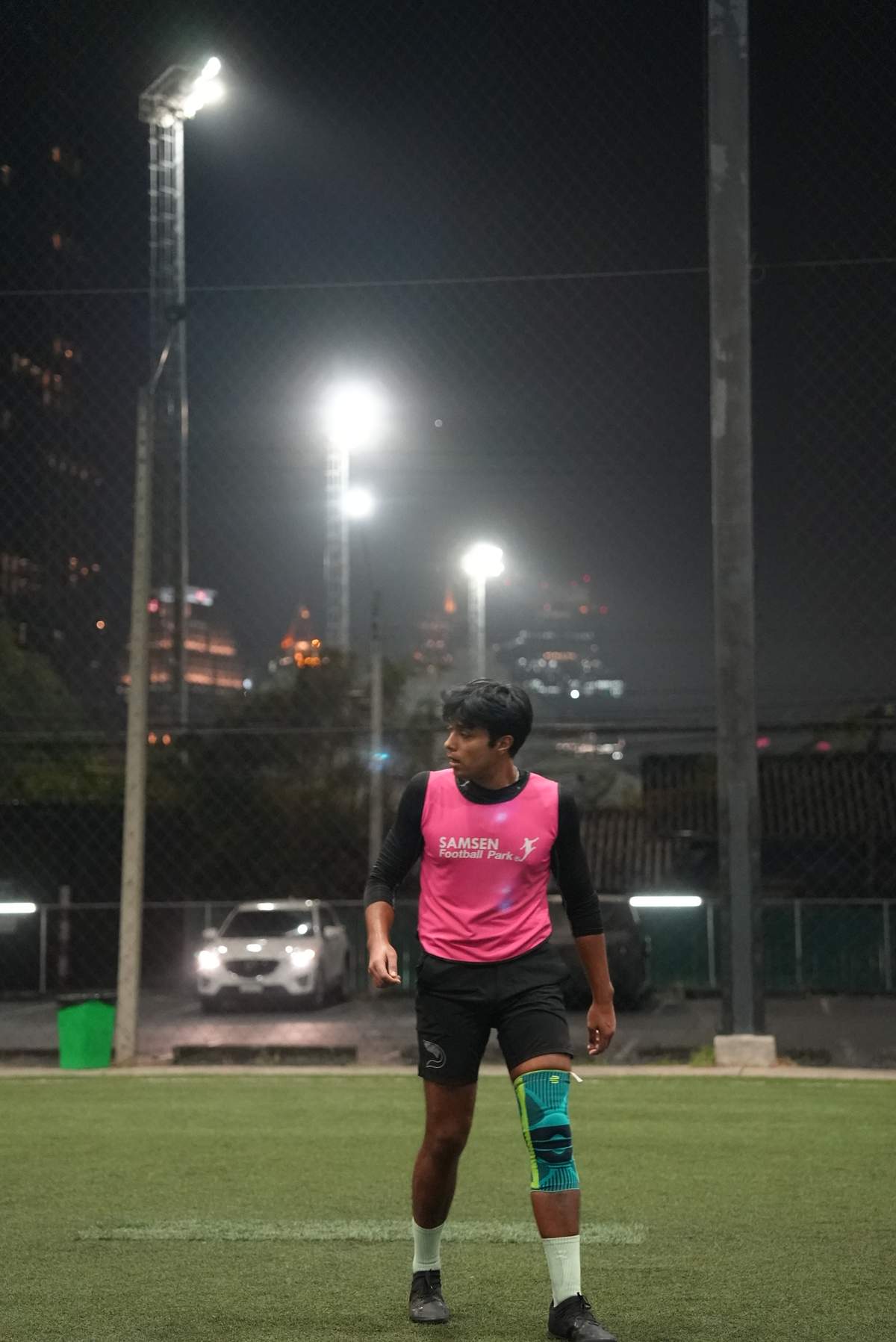
You join a pickup football game by showing up alone, paying for a spot, and playing. No tryout, no invitation. If you are nervous about your first time, most players felt exactly that way before their first game. The anxiety fades within ten minutes, because everyone is too focused on the ball to care whether you are new.
Before the how, a quick what, since a lot of people search for that first.
What is pickup football?
Pickup football is a casual game you join as an individual, without belonging to a team or a club. You book or turn up, get put on a side that day, play, and leave. There is no season, no squad, no commitment to come back.
It is different from club or league football, where you sign up, pay subs, and are expected at every fixture. Pickup is the opposite arrangement. You play the games you feel like playing, when you feel like playing them.
Locally in Southeast Asia the same thing is often called futsal when it is small-sided. The format is usually five-a-side or seven-a-side on a small pitch, which keeps the pace high and means everyone gets plenty of touches. It is built for exactly the person reading this: someone who wants a regular game without having to organise one or join anything.
Why everyone feels nervous before their first game
The fear is social, not physical. You are not worried about pulling a muscle. You are worried about being the worst player, standing around awkwardly, disrupting a group that already knows each other. Those fears make sense, but they do not match what actually happens.
Pickup football communities exist because people want to play without committing to a full team. In Bangkok alone, more than 2,000 players from over 70 nationalities play pickup weekly, and KickHub now runs in Bali too. The player pool rotates constantly. Expats move in and out. Tourists join for a week. Locals try it on a whim. New faces are the norm. Nobody tracks who has been around the longest.
A Thai player named Thoi showed up to his first game without knowing anyone. He was quiet, clearly uncomfortable, the kind of guy who stays near the sideline and avoids eye contact during warmups. He wanted to play with expats and improve his English but did not know how to start a conversation. That was months ago. He now plays at least three times a week. His English went from basic pleasantries to full conversations mid-game. Football forced the interaction in a way that language apps and networking events never could. You have something to do together from the first second, so the need for small talk disappears.
How to pick the right game for your first time
Not all pickup games are the same. How the game is organized and how you book your spot matters more than you would expect, especially the first time.
Booking platforms
A structured platform where you pay per spot is the easiest entry point. You book online, you show up, everyone has paid the same amount, and the organizer manages the game. KickHub runs 40+ games a week in Bangkok, plus daily games in Canggu, Bali. Most are 7-a-side, 60 minutes, with teams balanced at the start. Prices vary by venue and by how early you book, starting from around 230 THB in Bangkok, so the app is the place to check the exact rate.
The system treats every player the same. You paid, you play. There is no inner circle deciding who gets more pitch time.
If you want proper eleven-a-side rather than small-sided, that now exists too, on Saturdays at Hybrid Football Field. More on the different options in the Bangkok football clubs guide.
WhatsApp and Facebook groups
These work, but the experience for newcomers varies. They are usually cheaper and community driven. Some groups are welcoming. Others are cliquey.
I learned this the hard way with a WhatsApp group in Bangkok. It was mostly locals who had played together for years. They invited random players to fill spots and split the cost. I spent two hours at the venue but played maybe 30 minutes. Newcomers sat on the bench while regulars rotated their own friends in. Nobody said anything hostile. They just did not include me. This happens in several groups across Bangkok. When the organization is informal, the people running things favor their circle. Not out of malice, just human nature.
If you are already nervous about joining, being sidelined at your first session will kill your motivation to try again. A structured booking removes that risk.
Showing up at a pitch
The old school approach. Go to a venue during peak hours (weekday evenings, 7 to 10 PM), watch the games, talk to the reception staff. They know who plays regularly and can point you in the right direction. This takes more initiative but works if you live near a specific venue and want to find its regular crowd.
What happens when you arrive
You walk in, check in at the front desk or with the game organizer, put your boots on, and join the warmup. Teams get picked, usually by the organizer balancing skill levels or sometimes just alternating picks. The game starts.
Nobody asks for your football resume. The whole thing is informal. If you make a bad pass, nobody remembers it ten seconds later. If you score, people cheer. If you miss an open net, someone laughs and you laugh with them.
The first five minutes feel strange because everything is unfamiliar. By the fifteen minute mark you are just playing football. By the end of the session you have exchanged a few words with teammates, maybe learned a name or two. You do not need to be the life of the party. Just showing up again next week does most of the work.
What to expect from the skill level
This is the second biggest worry after social anxiety. "What if I am terrible?"
Most pickup games have a wide skill range. You will find former university players alongside people who last kicked a ball in school. The 7-a-side format helps. The pitch is small, so everyone touches the ball often, and the pace is fast enough that individual mistakes get forgotten in seconds.
If you have not played in years, you will be fine. You might be breathing hard after 20 minutes, but your skill level will not be a problem. Do not overthink your positioning or try fancy moves. Pass the ball to the nearest teammate and run into space. That is 80% of pickup football.
If you are worried, look for sessions tagged as "all levels" or "social" rather than "competitive." Most games lean social, because the majority of players are there for exercise and to meet people.
The heat factor
Bangkok is hot, and so is Bali. If you have just flown in from Europe or North America, your body is not adapted. You will gas out faster than usual during your first few games. Drink water before you arrive, not just during the game. Bring a towel. Your fitness will be lower than normal for the first two weeks. Everyone goes through it.
Evening games are more bearable than afternoon sessions. The temperature drops once the sun goes down, which is exactly why most games run in the evening. Pick a later slot for your first game if you can.
How to book your first game
- Download the KickHub app.
- Pick a game that fits your schedule and location. In Bangkok the most active venues are POLO in Lumphini, OASIS in Sathon, Hybrid Football Field, and Soccer Pro at On Nut 17 and Ratchada 18. In Bali it is The Kick Off Arena in Canggu. The venue map shows what is on at each one.
- Pay for your spot in the app. The rate depends on the venue and how early you book.
- Show up 10 to 15 minutes early. Bring boots, shin guards, and water.
- Play.
No registration form, no fitness test.
What to bring
Football boots or turf shoes (the pitches are artificial turf, so turf shoes or moulded studs work best). Water, a towel, and shin guards if you own them. Shin guards are not mandatory in most pickup games but they save you from accidental stud rakes.
Do not worry about wearing matching kit or knowing the rules of 7-a-side versus 11-a-side. The differences are minor and you will figure them out in the first two minutes. Most players wear whatever random shirt they have.
After the first game
The second game is easier because you already know what to expect. You might recognize a face or two. Someone might wave at you. It compounds faster than you would think.
If you want to speed up the social side, play the same time slot consistently. Tuesday 8 PM, every week. You will see the same group within two or three sessions, and familiarity does the rest.
Most regular players started where you are now. Nervous, unsure, slightly out of their depth. A month of consistent play and that feeling is gone. A few months later, you are the one nodding at newcomers.
If you are in Bali rather than Bangkok, the same thing applies, and the Canggu football guide covers where and when the games run there.
FAQ
What is pickup football?
A casual game you join as an individual, without a team or a club. You book a spot, show up, get put on a side that day, and play. No season and no commitment to return. Locally it is often called futsal when it is small-sided.
How do I join a pickup football game?
Book a spot on a platform like KickHub, show up, and play. There is no tryout and no invitation needed. You can also find games through WhatsApp or Facebook groups, though the experience for newcomers is less predictable.
Do I need to be good at football?
No. Most pickup games mix all levels and balance teams on the day. Former university players and complete beginners play in the same games.
Can I go alone?
Yes. Most people show up alone. Teams are formed on the day, so you do not need to bring anyone.
How much does it cost?
It varies by venue and by how early you book, starting from around 230 THB in Bangkok and 172,000 IDR in Bali. Check the KickHub app for the exact rate on a given game.
What should I bring to my first game?
Boots or turf shoes, water, a towel, and shin guards if you have them. Everything else is handled on the day.