
Where to Play Pickup Football in Bangkok (2026 Guide)
Find the best pickup football games in Bangkok. Venues by area, what it costs, 40+ weekly games, and how to book your first 7-a-side match.

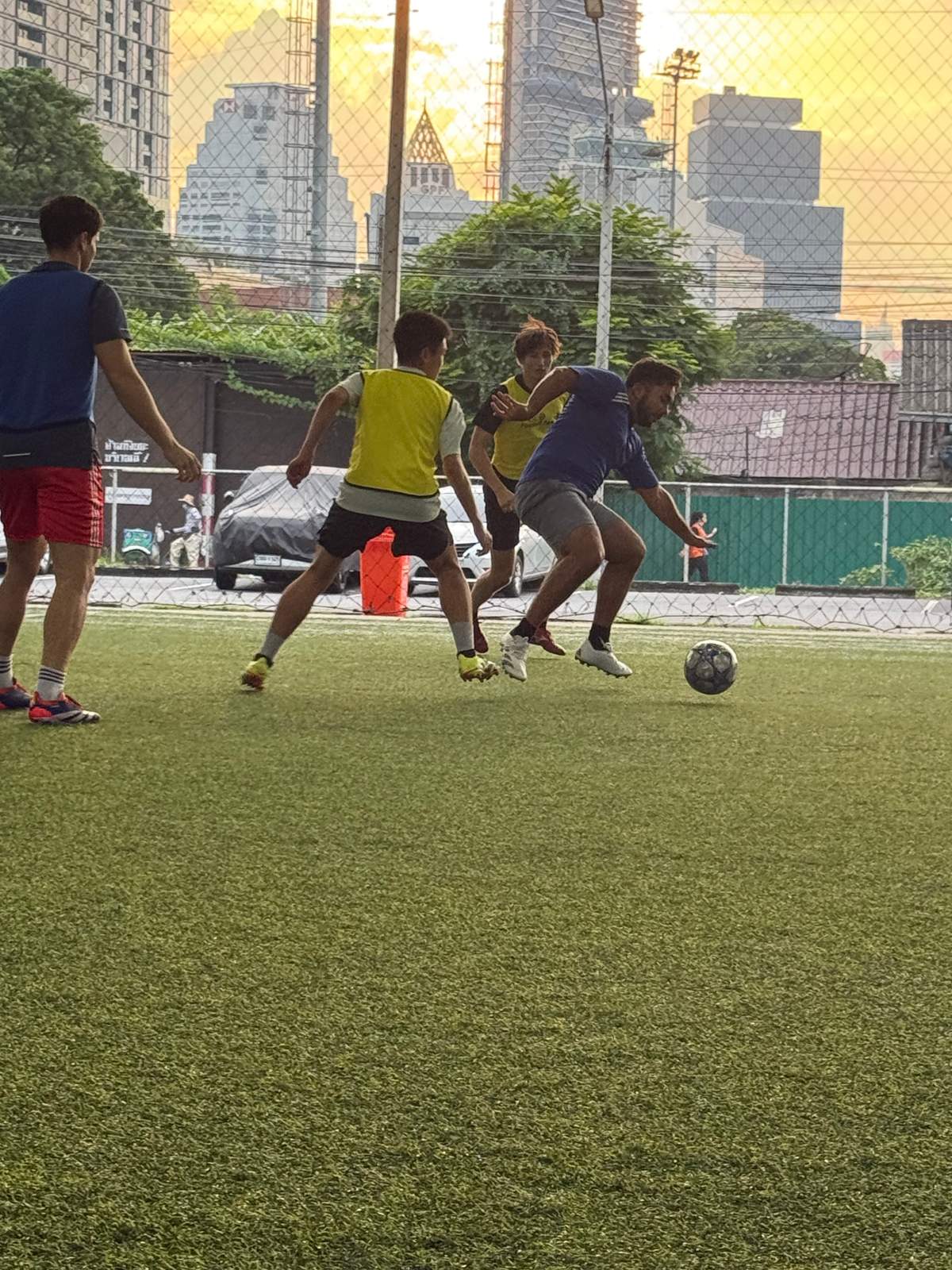
The best way to play pickup football in Bangkok right now is to book a 7-a-side game through a platform like KickHub, show up at the pitch, and play with whoever else signed up. You do not need a team, and nobody expects a commitment. Games run most evenings across the city.
Bangkok is one of the best cities in Southeast Asia for casual football. KickHub alone has more than 4,000 registered players from over 120 nationalities. The pitches are good, the games are frequent, and newcomers get absorbed fast. But figuring out how to actually get into a game when you first arrive can be confusing.
How expats find games
There are really only three ways expats find pickup football in Bangkok. Each one works, but they fit different types of players.
Booking platforms
The most reliable option. KickHub runs 40+ games per week across multiple venues. You open the app, pick a date and pitch, pay upfront, and show up. Everyone who booked is confirmed, so no-shows are rare. Around 95% of spots get filled, meaning popular time slots sell out a day or two in advance. Format is 7-a-side, usually 60 minutes. A spot costs the same whichever way you pay, late bookings cost more, and the current prices are in the Bangkok guide.
The main advantage of a booking platform is predictability. You know exactly when the game starts, how many players are coming, and what the level looks like based on who typically plays that slot.
Community groups
Bangkok Football Meetup is the oldest community option, running games on Wednesday, Friday, and Sunday evenings at 150 baht per session. Everything is coordinated through WhatsApp. You message the group, confirm you are coming, and transfer the money. More casual format, lower pricing, tight-knit community. The trade-off is that organization depends on a few volunteers, and games occasionally get cancelled if not enough people confirm.
There is also the playing time issue. KickHub's founder experienced this firsthand with a WhatsApp group in Bangkok. He showed up for a two-hour session and spent most of it on the bench. The regulars who ran the group prioritized their own circle, and newer players barely touched the ball. He played maybe 30 minutes out of two hours. This is not unusual in Bangkok. Several informal groups work the same way, which makes it hard for solo players to get consistent game time when they rely on WhatsApp or Facebook to find matches.
Bangkok Footy Casuals on Facebook has over 4,000 members and is the largest English-speaking football group in the city. People post about pickup games, league tryouts, and venue recommendations. Less structured than a booking platform but good for finding one-off games and meeting people in the football scene.
Expat.com forums still get regular threads about football in Bangkok. The information is hit or miss (posts can be months or years old), but worth scanning if you want to find niche groups or specific neighborhood games.
Word of mouth at the pitch
This is the old-school method and it still works. Go to a venue like Soccer Pro or Polo during peak hours (weekday evenings, 7 to 10 PM) and watch the games. Talk to the reception staff. They usually know which groups play regularly and can point you toward a team that needs an extra player. Some venues have bulletin boards or LINE groups for their regular community.
This method takes more effort upfront, but it is how most long-term residents found their regular games before booking platforms existed.
Pitches by area
Bangkok is spread out, and traffic means that a venue 15 kilometers away can take over an hour to reach. Picking a pitch close to where you live or work matters more than finding the theoretically "best" venue in the city.
Sathon and Lumphini
Polo Football Park is right off Wireless Road in Lumphini. It is the most popular expat football venue in Bangkok. Good turf, strong floodlights, and central enough that players from Silom, Sathon, and Sukhumvit can reach it without too much hassle. Hourly rental runs 1,300 to 2,000 baht for the whole pitch. If you book through a platform, your per-player cost is much lower. On a busy evening, Polo feels like a proper football night. Players from a dozen countries, the sound of the game carrying across the park, groups hanging around after the final whistle. On Sunday mornings, the group has done brunches after the match. One player who runs a bakery in Bangkok brought fresh tarts for everyone. Thursday evenings are different. Players show up with their regular teams and the intensity goes up. Same pitch, completely different energy depending on the day and who signed up.
OASIS is nearby in Sathon. Less traffic, smaller crowds, good pitch. Worth trying if Polo is fully booked or you prefer somewhere calmer.
Both venues are walkable from BTS Sala Daeng or MRT Lumphini, which makes them the most accessible options for anyone living along the Silom or Sukhumvit BTS lines.
Sukhumvit and east
Arsenal Soccer School on Sukhumvit 71 (Phra Khanong area) is popular with the Bangkok Footy Casuals community. They have 5-a-side astro pitches, a 7-a-side option, and an 11-a-side grass pitch for league games. Proper changing rooms and a small clubhouse. The skill level here runs slightly higher than casual pickup, so it fits if you have played regularly before.
Arena 10 in Thonglor is where the after-work crowd goes. Convenient if you live or work in the Thonglor-Ekkamai area and want to play without sitting in traffic.
The Sukhumvit corridor has the highest concentration of expat players. If you are based anywhere between Asoke and On Nut, you will have multiple venues within a 15-minute taxi ride.
On Nut and south
Soccer Pro has seven branches across Bangkok. The On Nut location is the most accessible for south-side residents. Pitches rent from 500 to 1,150 baht per hour, 40 to 50 percent cheaper than Polo. Multiple pitch sizes, adequate lighting, parking. Nothing fancy, but the facilities work. For regular players going three or four times a week, the lower cost adds up over a month.
Grand Soccer Pro On Nut is reachable from BTS On Nut. The player mix here is more varied than at the central venues: expats, Thai players, and university groups.
For the full story of how the expat football scene works in Bangkok, read Ludovic's complete guide. New to pickup? Start with how to join your first game.
Your first game
The format
Most pickup games in Bangkok are 7-a-side on artificial turf, 60 minutes. The organizer or a couple of players pick teams at the start, either randomly or trying to balance skill levels. You rotate on and off if there are extra players. There is no referee. Self-officiated, which works better than you would expect once people know each other.
Showing up solo
Walking onto a pitch where you do not know anyone feels uncomfortable. But nobody cares. Everyone there showed up solo at some point. In a city where the average expat stays 18 months to 3 years, the player pool constantly rotates. New faces are normal. The games are built around individual bookings, not pre-formed teams.
One of the most regular players at KickHub now is a Thai local who showed up to his first game knowing nobody. He wanted to mix with expats and practice his English but was visibly nervous. That was months ago. He now plays at least three times a week, his English has improved, and he went from barely speaking to anyone to being one of the most social players on the pitch. Running around together for an hour does more for that than any networking event or language class.
Introduce yourself to the organizer or the person at the front desk. Get on the pitch. Play. By the end of the first game, you will have talked to at least three or four people. By your third game, you will recognize regulars.
Skill level
Bangkok pickup games attract a wide range. Some players are former semi-professionals. Some have not played since school. Most are somewhere in the middle. Weekday evening sessions are the most balanced. Weekend mornings sometimes skew higher in intensity. If you are worried about being out of your depth, start with a midweek game at a mid-range venue. More social than competitive.
The heat
If you are coming from Europe or North America, this will be your biggest adjustment. Bangkok is hot year-round, and the humidity makes it worse. Evening games starting after 7 PM are the most comfortable, but even then you will sweat more in 60 minutes than you did in a full 90-minute game back home. Drink water before you arrive, not just during the game. Bring a towel. Wear light gear. If you are arriving during the hot season (March through May), consider shorter sessions or pitches with overhead fans on the sideline. In April, a tourist from London played his first game at KickHub. He lasted about three minutes before asking to come off. The humidity destroyed his cardio. He holds the unofficial record for shortest playing time. If you are arriving from a cooler climate and have not been exercising in the heat, take your first session at 60 percent intensity and see how your body responds.
During monsoon season from May to October, rain can interrupt games. Indoor futsal venues become more popular. Bangkok has several air-conditioned futsal courts that operate year-round, though the game feels different on a hard court compared to turf.
Why people play five times a week
On any given evening you might play alongside a French banker, a Thai university student, a Brazilian digital nomad, and a retired British engineer. The stuff that happens before and after the whistle matters as much as the game. Players grab food together after matches. Group chats develop. Weekend plans form. People who arrived in Bangkok knowing nobody end up with a regular social circle within two or three weeks of playing.
It goes further than that. Players who run e-commerce businesses have found clients on the pitch. Others have introduced contacts that helped someone launch a new venture. Nobody is trying to network. It just happens when you see the same people several times a week.
Bangkok can be isolating despite its size. The language barrier makes casual socializing harder, and most expats cycle through every couple of years, so friendships take effort to maintain. Football gives you a recurring reason to see the same people, doing something active, with no social pressure beyond showing up and playing.
The Player of the Month leaderboard that some platforms run adds a light competitive layer. You earn points for playing regularly, and the top players get small rewards at the end of each month. Enough to keep regulars showing up without making it too serious.
What it costs
Per-game costs:
| Option | Price | What you get |
|---|---|---|
| Bangkok Football Meetup | 150 THB (~$4.20) | WhatsApp-organized, Wed/Fri/Sun |
| KickHub | Current prices | Confirmed booking, daily options; late bookings cost more |
Monthly scenarios:
Playing two or three times a week through a booking platform costs about the same as a mid-range gym membership in Bangkok, which runs 2,000 to 4,000 baht per month, without the social side.
KickHub also has a wallet: top up once in the app and book from your balance. It is a way to pay, not a cheaper seat.
Gear:
You do not need much. Football boots with short studs or turf shoes work on artificial pitches. Lightweight shorts and a breathable shirt. Shin guards are optional at most pickup games but recommended. A full kit from a Bangkok sports shop costs 1,500 to 3,000 baht. Cheaper options at Chatuchak Market or on Lazada.
When to play
Best time of day: 7 PM to 10 PM. The heat has dropped, the pitches are floodlit, and this is when the most games run. Saturday and Sunday mornings (7 to 10 AM) are the second most popular window.
Best time of year: November through February. Temperatures drop to the mid-20s in the evening, humidity is lower, rain is rare. Peak season for expat football in Bangkok, and games fill faster during these months.
Rainy season (May to October): Games still run. The rain usually comes in short, heavy bursts rather than all-day drizzle. Most pitches have drainage that handles moderate rain. If a serious storm hits, games get rescheduled. Having an indoor futsal venue as a backup is smart during these months.
Avoid: Midday games from March through May unless you are acclimated to tropical heat. Direct sun at 38 degrees with high humidity is dangerous for intense physical activity.
FAQ
Do I need to bring my own team?
No. Every pickup game in Bangkok is designed for individual signups. You book a spot, show up, and teams are formed on the night.
What if I have not played in years?
Start with a midweek evening game. The intensity is lower, the atmosphere is social, and nobody expects match fitness. Most players took a break at some point and came back through casual pickup.
Is there football for women in Bangkok?
Yes, though options are more limited. Some booking platforms run mixed games, and there are women-only sessions organized through Facebook groups. The AFL Bangkok league has a women's division. Ask in Bangkok Footy Casuals for current schedules.
Can I play as a tourist visiting for a few days?
Yes. Most booking platforms do not require a subscription. You can sign up, book a single game, and play that same evening if spots are available.
What language do people speak during games?
English is the default in expat pickup games. On the pitch, communication is minimal anyway. Off the pitch, most conversation happens in English. Some venues with more Thai players use Thai, but you will manage with basic gestures and football vocabulary.
Are the pitches safe?
Artificial turf pitches in Bangkok are well maintained. The main risk is heat-related. Stay hydrated, recognize the signs of heat exhaustion (dizziness, nausea, confusion), and do not push through if you feel off. Turf burns from sliding are common. Long socks and proper footwear help.
KickHub is available as a free app on the App Store and Google Play, and at kickhub.app.
For the full story of how expat football works in Bangkok, read The Complete Guide to Expat Football. New to pickup? Start with how to join your first game.